---
title: "Migrating from reCAPTCHA"
description: "Replace Google reCAPTCHA with Edge Shield in under an hour: swap the script tag, update one server call, and map v3 scores to the 1–100 humanity score."
url: "https://edge.network/academy/migrating-from-recaptcha"
category: "Security"
readingTime: "3 min"
level: "intermediate"
---
# Migrating from reCAPTCHA
Swap Google reCAPTCHA for Edge Shield in under an hour: one script tag, one server call, and your visitors never squint at traffic lights again.
## Why teams are moving
Three pressures usually trigger the migration:
- **Conversion:** image challenges measurably cost signups, and AI now solves them better than humans do, so the friction buys less protection every year.
- **Privacy:** reCAPTCHA sets Google cookies and feeds behavioural data across sites, which drags your forms into GDPR consent territory.
- **Cost:** the free tier caps at 10,000 assessments a month, and real traffic graduates to Enterprise pricing.
Edge Shield is free without limits, collects no per-visitor data, and replaces puzzles with an invisible proof-of-work plus a 1–100 humanity score your server acts on.
| | reCAPTCHA | Edge Shield |
|---|---|---|
| Human experience | Image puzzles when suspicious (v2); silent but score-gated (v3) | Invisible; at worst a single click, never a puzzle |
| Score | 0.0–1.0 (v3 only) | 1–100 on every verification, all modes |
| Privacy | Google cookies and tracking across sites | No cookies, no fingerprint DB, no per-visitor data |
| Pricing | Free to 10k assessments/mo, then paid (Enterprise) | Free forever, unlimited |
| Consent banners | Usually required under GDPR | Nothing collected, nothing to consent to |
| AI agents | Treated as attacks | Cryptographically identified and routable |
## 1. Create your Shield widget
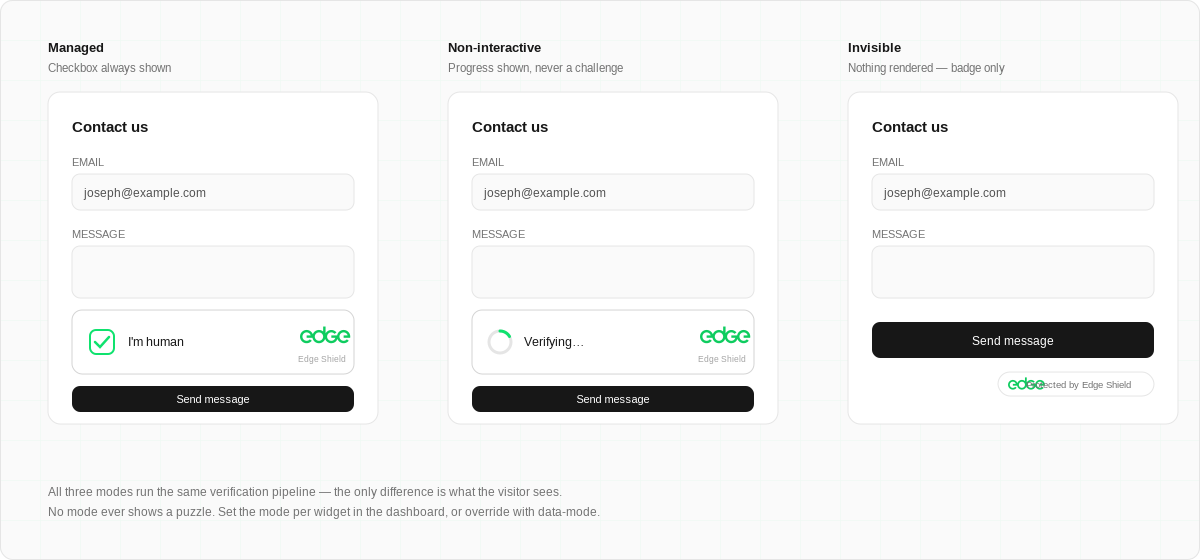
In the [console](/console), go to **Shield → Create Widget**. Name it, optionally pin it to your hostnames, and keep the default **managed** mode. It behaves like reCAPTCHA v2's "invisible" mode, escalating to a single click only for suspicious traffic. You'll get a sitekey (public) and a secret (server-side, shown once), directly replacing your reCAPTCHA key pair.
## 2. Swap the client-side snippet
```html
```
```html
```
The token lands in a hidden `edge-shield-response` input on submit. If you used the JS API (`grecaptcha.render`, `grecaptcha.execute`), the equivalents are `edgeShield.render()` and `edgeShield.execute()`. See the [JS API docs](/docs/shield/js-api) for SPA patterns.
## 3. Update the server-side verification
Same pattern, different URL and field name. The response shape is deliberately familiar, with `success`, `hostname`, `challenge_ts` and `error-codes`:
```js
// Before: reCAPTCHA siteverify
const res = await fetch('https://www.google.com/recaptcha/api/siteverify', {
method: 'POST',
headers: { 'Content-Type': 'application/x-www-form-urlencoded' },
body: `secret=${SECRET}&response=${req.body['g-recaptcha-response']}`,
})
const { success, score } = await res.json() // score: 0.0 – 1.0
```
```js
// After: Edge Shield siteverify
const res = await fetch('https://shield.edge.network/siteverify', {
method: 'POST',
headers: { 'Content-Type': 'application/x-www-form-urlencoded' },
body: `secret=${SECRET}&response=${req.body['edge-shield-response']}`,
})
const { success, score } = await res.json() // score: 1 – 100
```
**Score mapping:** if you gate on reCAPTCHA v3 scores, multiply your thresholds by 100, so a `0.5` cutoff becomes `50`. One behavioural difference to know: Shield tokens are strictly single-use, so validate at the moment you process the form, not ahead of it.
## 4. Verify, then remove Google
1. Test a real submission and watch the verification land in your widget's metrics in the console.
2. Submit with the token replayed (or missing) and confirm your server rejects it.
3. Remove the reCAPTCHA script tag, keys, and any `google.com/recaptcha` entries from your CSP.
4. If your privacy policy or consent banner mentioned reCAPTCHA, simplify it. Shield collects nothing that needs consent.
Migrating from **Cloudflare Turnstile** is even simpler, because Shield supports a drop-in compatibility mode. See [the Turnstile migration guide](/docs/shield/turnstile-migration).
## Next steps
- [Try the live demo](/shield/demo)
- [Bot protection with Edge Shield](/academy/bot-protection-shield)